
Diploma in Civil Engineering: Scope, Jobs Salary in India
30 June 2026
Choosing the right course after school can completely change your life. If you have an interest in the construction sector, a diploma in civil engineering is a great choice for you. This short-term professional course teaches you the basic skills of construction, surveying, and structural design. It helps you get ready for the real world quickly without spending too many years in college.
Because India is growing so fast, this technical field offers some of the highest job security for young people. The government and private sectors are launching massive infrastructure projects daily, meaning specialized technicians are needed everywhere. By jumping straight into a practical learning track, you can bypass long years of theoretical studies, secure professional skills, and start earning a high income at an early age.
What is a Diploma in Civil Engineering?
This course is a three-year technical program that you can join right after completing your Class 10 or Class 12 exams. While a regular B.Tech degree focuses heavily on complex theories and long math formulas, a diploma in civil engineering is completely different. It spends more time teaching practical skills like structural design, brick testing, map reading, and soil quality checking.
Because the training is practical, companies love to hire these students. You learn how to manage workers on a construction site, measure land accurately, and read blueprint engineering maps. It is the perfect path for students who want to start working early and earn money to support their families.
If you are looking for the right institute to start your journey, choosing the Civil Engineering Diploma at SNIT Gaya is an excellent option. This top college provides great labs, expert teachers, and practical site visits that prepare you perfectly for the competitive construction industry.
Why Choose a Civil Engineering Diploma?
The construction sector in India is growing incredibly fast every single day. The government is spending crores of rupees to build new smart cities, multi-lane highways, bullet train tracks, and massive airports. Every time a new bridge or building is planned, companies need smart supervisors to manage the daily work on the ground.
By completing a diploma in civil engineering, you open the doors to a very stable and long-term career path. You do not have to sit in front of a computer screen inside a dark office all day. Instead, you get to work in the fresh air on real-world projects, meeting new people and building structures that will stand for a hundred years.
Bright Career Opportunities After Civil Engineering Diploma
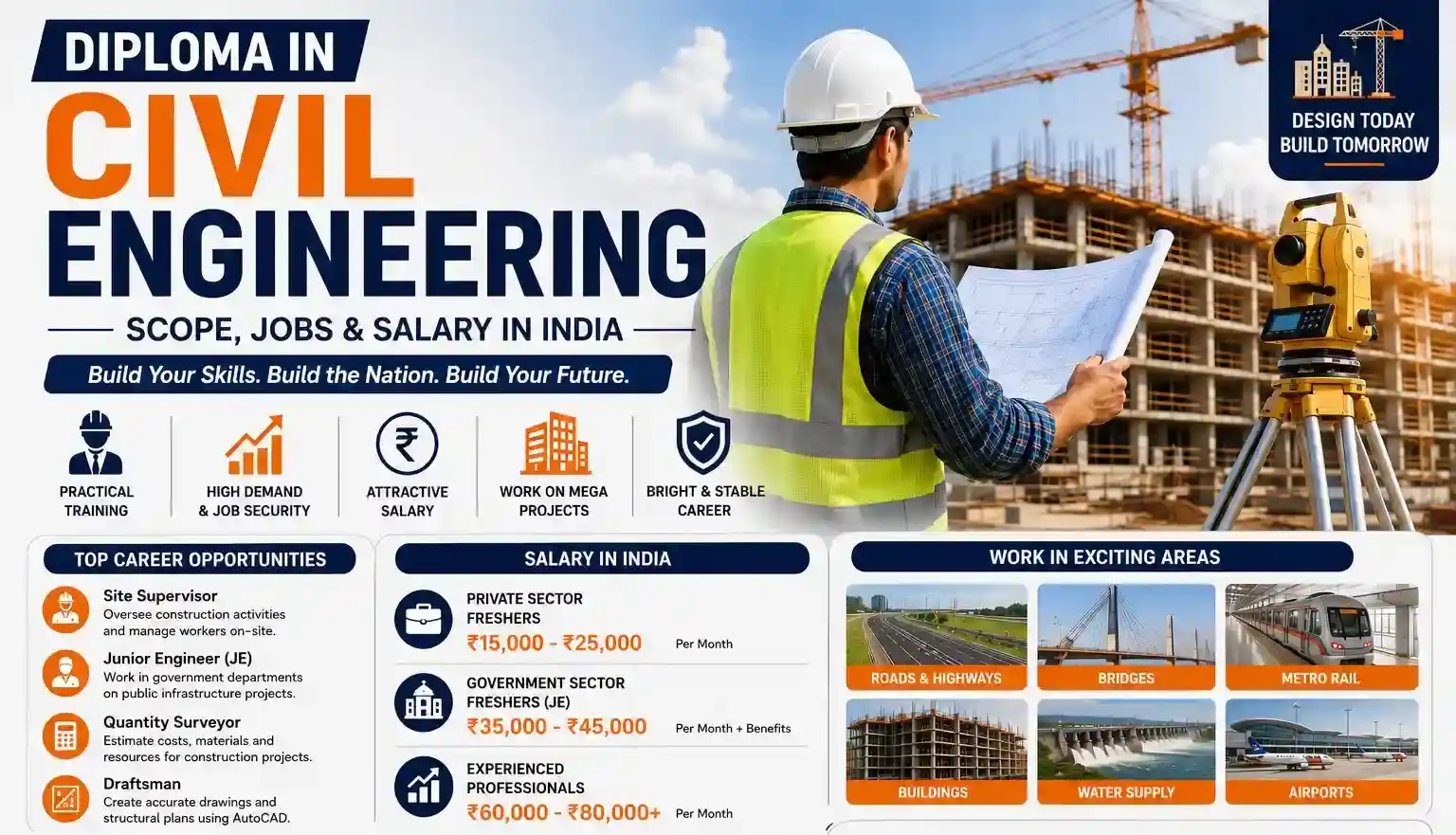
There are many diverse career opportunities after civil engineering diploma in both private companies and government departments. Since diploma holders are excellent at managing practical tasks on-site, they are always in high demand.
Here are some of the popular job roles you can get:
- Site Supervisor: You will stand on the construction site to watch the laborers and make sure the building is being built according to the engineering map.
- Junior Engineer (JE): This is a highly respected government job position where you help senior officers manage public projects like roads and water pipelines.
- Quantity Surveyor: Your job will be to calculate how much cement, steel, bricks, and money are needed before starting a construction project.
- Draftsman: You will use modern computer software like AutoCAD to draw neat, accurate maps and structural plans for buildings.
Finding the Best Civil Diploma Jobs
Once you finish your final exams, you can easily apply for various civil diploma jobs across India. Many top-rated private construction companies like L&T, Tata Projects, and Reliance Infrastructure actively hire diploma freshers directly from college campuses.
If you want a secure life, you can also study for government entrance exams. High-paying government sectors like the Indian Railways, Metro Rail Corporations, National Highways Authority of India (NHAI), and the Public Works Department (PWD) release thousands of vacancies every year specifically for junior engineers holding a diploma.
Expected Civil Engineer Salary in India
Your starting income depends heavily on your practical skills, your college reputation, and whether you land a job in the private or public sector. However, the average civil engineer salary in India is highly rewarding for young freshers.
- Private Sector Freshers: As a new site supervisor in a private company, you can expect to earn between ₹15,000 and ₹25,000 per month.
- Government Sector Freshers: If you clear a competitive exam and become a Junior Engineer, your starting salary will be much higher, usually between ₹35,000 and ₹45,000 per month, along with free housing and medical benefits.
- Experienced Professionals: As you spend 4 to 5 years on construction sites and learn how to handle big projects independently, your monthly income can easily cross ₹60,000 to ₹80,000.
Start Your Journey with SNIT Gaya
To grab the best jobs and secure a high salary, you need to learn from an institute that cares about your practical development. Pursuing a Civil Engineering Diploma at SNIT Gaya gives you that exact edge. The college has modern survey labs, advanced testing machinery, and strong tie-ups with construction companies to help you secure great job placements immediately after graduation.
Conclusion
A diploma in civil engineering is a highly practical, affordable, and secure career choice for young students in India. It bypasses long years of theoretical study and puts you directly on the path to financial independence. By learning the right skills, staying dedicated, and choosing a trusted college like SNIT Gaya, you can build a highly successful professional life. Take the first step today and start building the future of the nation!
Frequently Asked Questions

How Polytechnic Students Can Prepare for Government Jobs
10 September 2026
Best Career Opportunities After Polytechnic Diploma in Bihar
02 September 2026
What Is Polytechnic Diploma? Complete Guide After 10th
19 August 2026
Diploma Engineering vs 12th Science After 10th
18 August 2026