
Diploma in Computer Engineering After 10th: Career Scope, Salary & Admission Guide
19 June 2026
Are you thinking about what to do next now that your 10th board exams are over? If computers, apps, and technology excite you, then you do not have to wait for years to build your dream career. You can start right away by choosing a diploma in computer engineering. Among all the available options, it stands out as an incredibly popular choice for new-age students who want to become financially independent early in life.
This professional course is designed to teach you how computers work from the inside out. You will learn everything from hardware parts to software programming in a very practical way. Instead of just reading heavy theory books for years, you get to work in modern computer labs and build real skills. Doing a computer engineering diploma means you are choosing a path that skips long years of traditional school education and places you straight into a technical campus where learning is fun and career-oriented.
What is a Diploma in Computer Engineering?
A diploma in computer engineering is a three-year technical program that teaches you the basics of computer science. It is highly practical. The entire course is divided into six semesters. In these three years, you will study topics like computer programming languages, database management, computer networks, operating systems, and web development. The best part is that you do not need a background in science to start this journey. Anyone interested in computers can pursue a diploma after 10th grade.
It is completely focused on making you industry-ready. By the time your friends finish their regular high school and general college degrees, you will already have a professional certificate in your hand, along with the practical skills needed to crack technical job interviews. For students who want a fast-track career after diploma in computer engineering in Bihar, this course acts as a golden ticket.
Breaking Down the Timeline: Degree vs. Diploma
Let's look at your future timeline with direct honesty. A traditional four-year college degree takes a massive amount of your parents' hard-earned money and keeps you financially dependent on them for years. Choosing a smart diploma after 10th grade completely cuts that long cycle short, giving you real working confidence and independence at a very young age.
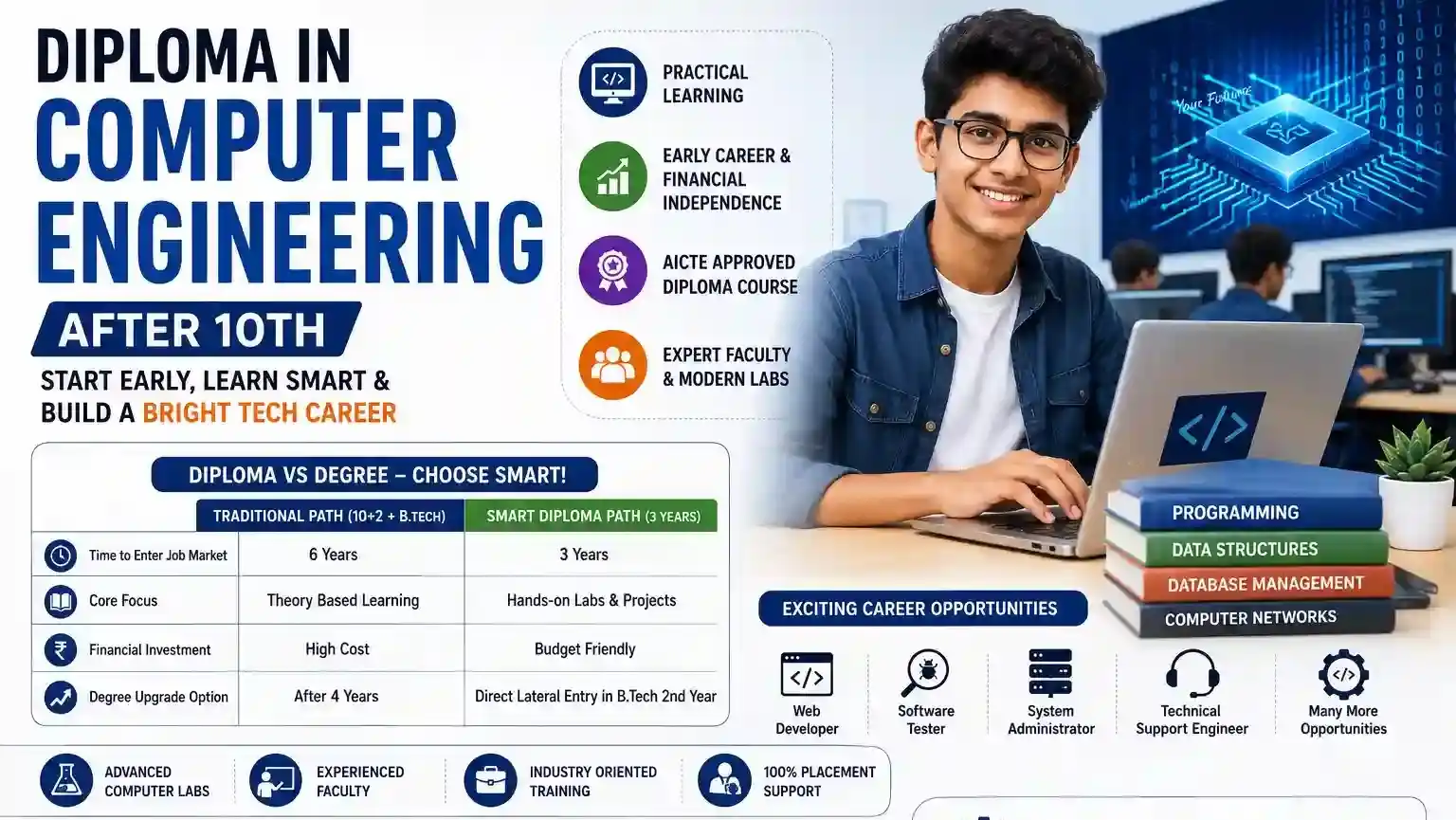
To see exactly how much time and money you save, look at this quick structural comparison:
| Career Factors | Traditional 10+2 + B.Tech Path | Smart 3-Year Technical Diploma Path |
|---|---|---|
| Time to Enter Job Market | 6 Years (2 years school + 4 years degree) | 3 Years (Direct entry after Class 10) |
| Core Focus | General science theory & textbook essays | Hands-on coding, labs, & live projects |
| Financial Investment | Extremely high fees over six full years | Highly budget-friendly local fees |
| Degree Upgrade Option | Requires finishing long secondary cycles | Direct Lateral Entry straight into B.Tech 2nd year |
Why Choose a Diploma in Computer Engineering?
The digital world is growing incredibly fast. Every business, school, hospital, and government office now runs on computers. This means the demand for skilled technical professionals is higher than ever before. Choosing a diploma in computer engineering allows you to tap into this massive job market at a very young age. It saves you time and gives you an edge over others.
Here are the main reasons why new-age students love this course:
- Practical Learning: You spend more time in computer labs playing with code than sitting in boring lectures.
- Early Financial Independence: You can start working and earning your own money just three years after your 10th boards.
- Direct Engineering Entry: If you wish to study further, you can get direct admission into the second year of a B.Tech degree through lateral entry.
Career Scope and Job Profiles
The career scope after completing this course is vast and exciting. Since technology is everywhere, companies are always searching for young talent who know how to manage software and hardware. You do not have to worry about finding work because the digital landscape is expanding every day.
After completing your computer engineering diploma, you can work in various exciting roles, such as:
- Web Developer: Designing and building beautiful websites for businesses.
- Software Tester: Checking apps and software programs to find and fix bugs.
- System Administrator: Managing the computer systems and IT networks of an office.
- Technical Support Engineer: Helping users solve their computer hardware and software issues.
Salary Expectation
One of the biggest questions students have is about the pay scale. For a fresh graduate holding a diploma in computer engineering, the starting salary is quite attractive. In India, a fresher can easily earn between ₹2,00,000 to ₹3,50,000 per year.
As you gain more experience, learn new programming languages, and improve your technical skills, your salary will grow rapidly. Within two to three years, many professionals double their income. If you decide to pursue a B.Tech degree later, your earning potential becomes even higher, opening doors to top-tier international tech companies.
Your Tech Launchpad: Shanti Niketan Institute of Technology
For students who want a modern, high-tech campus that gives them a massive practical edge right in the region, securing your SNIT Gaya Computer Engineering Diploma at the Shanti Niketan Institute of Technology is the perfect move. Built beautifully to move away from boring rote learning, this institute focuses entirely on hands-on application to prepare you for the demands of the modern market.
The campus features advanced digital computer labs, experienced coding mentors, and full training support to turn you into a top-tier software specialist. The professors treat you like junior colleagues, guiding you through live projects with patience. It is the ultimate local launchpad to turn your raw laptop passion into a highly respected, independent career.
Simple Admission Process Decoded
Securing your seat for the upcoming batches is a highly direct, transparent, and user-friendly process. You do not need to deal with confusing admission tests or hidden backend management donations. Admission is completely merit-based, calculated securely from your high school final marks.
- Check Eligibility: You simply need to pass your Class 10 board examinations from a recognized board with at least 35% aggregate marks.
- Submit Your Papers: Open the online college application page or walk straight into the administrative block to turn in your marksheet and identity proofs.
- Pick Your Core Stream: Sit down for a friendly, supportive counseling talk with expert guides to lock in your computer specialization.
- Secure the Registry: Hand over your basic documents and pay your initial enrollment installment to lock your name in the final batch registry.
Conclusion
Choosing a diploma in computer engineering right after your 10th standard is a highly rewarding career move for anyone passionate about technology. It completely cuts out the traditional route of long theoretical schooling and moves you straight into the practical, high-demand world of IT and programming.
If you want the perfect platform to transform your passion into technical expertise and secure a bright career ahead, your best choice is to enroll in an SNIT Gaya Computer Engineering Diploma. Whether you want to step into the corporate world instantly, secure early financial independence, or build a foundational stepping stone, this degree gives you a massive head start.
Frequently Asked Questions

How Polytechnic Students Can Prepare for Government Jobs
10 September 2026
Best Career Opportunities After Polytechnic Diploma in Bihar
02 September 2026
What Is Polytechnic Diploma? Complete Guide After 10th
19 August 2026
Diploma Engineering vs 12th Science After 10th
18 August 2026